Receive Daily Blog Emails
You agree to receive daily blog emails a link to the full blog contents. You can unsubscribe at any time.
Be Sure To Check Your SPAM Folder For Your Welcome Message and WHITELIST Our Email So It Doesn't Go To SPAM In The Future!
Why “Gulf of America” Upsets People & the Role of Branding in Geography
Saturday, February 01, 2025
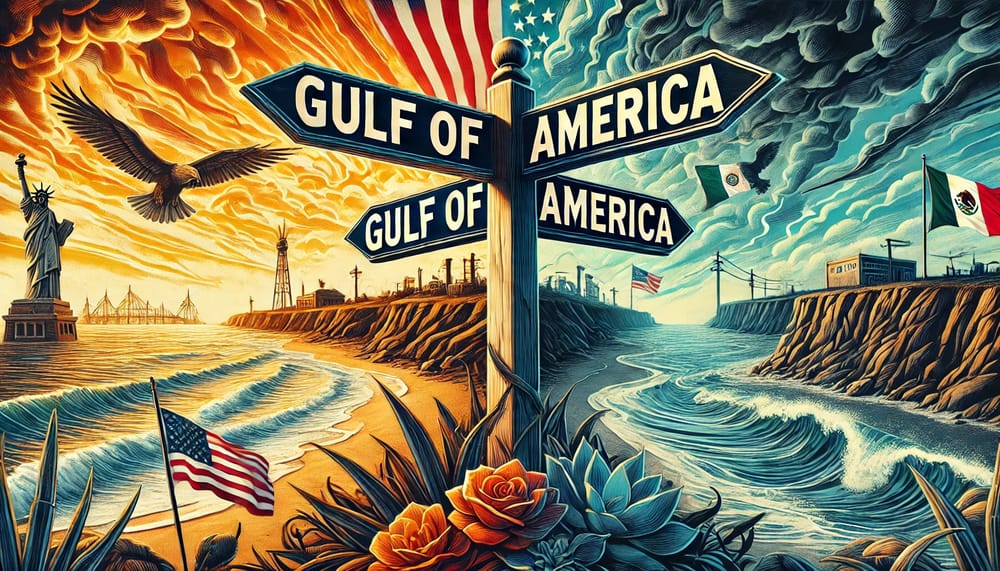
When it comes to naming geographic features, you’d think logic would prevail. But as we’ve often seen, emotions, history, and politics have a way of complicating even the simplest decisions. Which brings us to today’s topic—why something as straightforward as renaming the Gulf of Mexico to the “Gulf of America” has sparked widespread pushback, even though the region is, after all, part of North America.
Was this due to faulty branding? Could improved marketing have softened the blow or avoided the controversy entirely? Or is this pushback about something deeper? For digital marketers and geography enthusiasts alike, the case of the “Gulf of America” offers fascinating insights into human psychology, communication strategies, and the nuances of identity.
What’s in a Name? Geography Meets Emotion
On paper, renaming the Gulf of Mexico to the “Gulf of America” might seem logical. After all, the Gulf is a body of water in North America, and its coastlines touch the borders of several countries, including the United States. Many might assume “Gulf of America” is, therefore, a broader reflection of its physical geography.
But geography is rarely just about physical boundaries. Geographic names often carry emotional weight, serving as symbols of history, identity, and pride. For centuries, the “Gulf of Mexico” has been tied directly to Mexico, providing cultural and historical significance to the country and its people. Changing its name feels, to many, like erasing history or appropriating something deeply personal.
The pushback isn’t just about maps—it’s about narratives. Would altering the name diminish Mexico's identity in global consciousness? From Mexico’s perspective, the renaming could even appear as an attempt at domination, a subtle assertion of cultural or political superiority from the United States.
The Psychology of Geographic Identity
Humans experience a visceral connection to place names, attaching these to their sense of home, identity, and community. Changing a geographic label has the potential to create psychological dissonance, especially when people perceive the change as top-down or politically motivated.
Consider how people still, decades later, argue over whether it’s acceptable to call Myanmar "Burma" or New York City "York" (as it was before 1664). When names are shifted, it alters the way individuals relate to their own stories and histories. This emotional response explains why the inclusion of “America” in the Gulf's name is polarizing—it doesn't just update a name; it rewrites part of a shared story.
Where Logic Meets Backlash
Does the Name Reflect Reality?
One side of this debate argues that renaming the Gulf of Mexico to "Gulf of America" is based purely on logic rather than aggression. After all, the United States isn't the sole beneficiary of the Gulf; its waters extend to Cuba and the western Caribbean too. A broader term like “America” might, in theory, be inclusive of the entire region.
However, the term "America" is inherently contentious. Most people outside (and even within) the United States associate "America" exclusively with the USA, rather than the broader Americas. Using “America” in this context leans toward a US-centric worldview, dismissing the other nations connected to the Gulf, including Mexico.
For digital marketers, this illustrates how even seemingly innocuous language can alienate various segments of an audience—an important lesson when crafting campaigns for diverse markets.
Historical Context Adds Weight
It’s also important to remember how much weight history gives the name “Gulf of Mexico.” This area has been associated with Mexico since the early days of exploration and colonization. By tying the Gulf's identity to Mexico in its name, history acknowledges the integral cultural and political roles Mexico has played in the region’s past.
Changing its name to the "Gulf of America" discounts or at least downplays that rich context. And herein lies a problem often encountered in rebrands or name shifts—the perception that the current identity isn’t “good enough.” For many, this implies a forced erasure or disrespect of existing stakeholders.
Could Branding Have Saved the “Gulf of America” From Controversy?
What if this transition had been approached not as a logical renaming, but as a rebranding effort? Could better marketing strategies have made “Gulf of America” more palatable—or even embraced?
Here’s how the “Gulf of America” debacle could’ve benefited from branding principles familiar to digital marketers:
1. Stakeholder Engagement Matters
One glaring issue around renaming the Gulf stems from perceived unilateral decision-making, which alienates key stakeholders (such as Mexico).
Marketing equivalent? You wouldn’t launch a product without consulting your target audience or key partners first. Collaborative discussions that include all stakeholders—such as Mexico, Cuba, and other Caribbean nations—could have framed the name-change conversation in a constructive, cooperative way.
2. Storytelling Drives Acceptance
Every successful rebrand includes a compelling narrative that explains the "why." Without a meaningful story tied to the “Gulf of America” naming decision, confusion and resentment were inevitable. Had communicators tied the name back to shared geography, environmental conservation, or important economic collaboration across nations, people might have accepted it more easily.
3. Strategic Messaging is Key
Words matter—not just geographically, but in campaigns too. Imagine “The Gulf of the Americas” as an alternative branding option. Many would feel it better reflects the multinational nature of the region. Simple tweaks can remove perceptions of bias or imbalance while achieving the same broad goals.
4. Cultural Sensitivity Shapes Perception
Rebranding efforts often fail when they don’t account for cultural nuances. By understanding the emotional and historical connection Mexico (and its citizens) has to the Gulf, strategists could have sidestepped opposition.
From Landscape to Lessons
This situation offers an important takeaway for digital marketers, geographers, and leaders alike—it highlights the undeniable fact that identity, history, and emotions will always play a role in how names are perceived. Changing geographic features (or launching any global campaign) requires more than logical argumentation; it requires a human approach.
Whether you're renaming a product line, advising on brand positioning, or yes, relabeling a body of water, remember these core principles:
- Engage stakeholders early to ensure inclusivity
- Build compelling stories around your decisions
- Use precise and culturally sensitive language
- Acknowledge historical context
Marketing isn't just selling—it’s creating connections. If the “Gulf of America” transition was meant to forge stronger ties across North America, ironically, it may have done the opposite. But we can learn from this example and ensure thoughtful communication improves brand transitions in the future.
For more online marketing insights, click the link and come join my FREE Facebook Mastermind Group.

Tim Hewitt, Author
Tim is a Freelance Digital Marketer who specializes in helping other marketers to find ways to earn online. When you are frustrated with your prior efforts, Tim will help you find the way!
Copyright © 2026, The Digital Marketing Buzz | All Rights Reserved.