Receive Daily Blog Emails
You agree to receive daily blog emails a link to the full blog contents. You can unsubscribe at any time.
Be Sure To Check Your SPAM Folder For Your Welcome Message and WHITELIST Our Email So It Doesn't Go To SPAM In The Future!
When the Crown Slips: Burger King's Royal Makeover
Monday, March 30, 2026
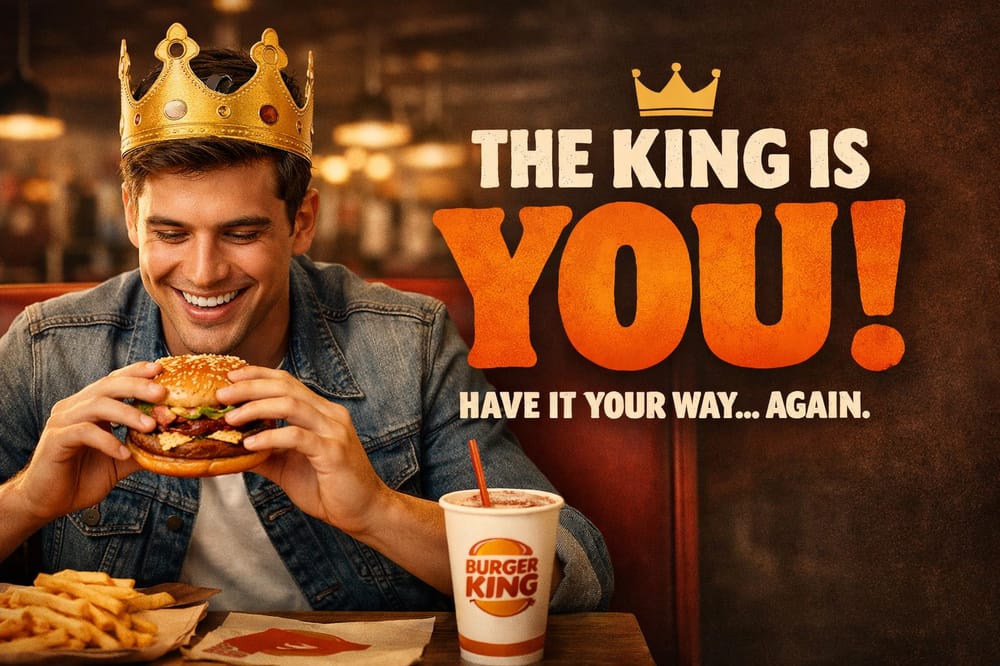
There's a quiet revolution happening inside one of the world's most recognizable fast food chains - and it doesn't involve a new burger. Burger King, the flame-grilled challenger that once dared McDonald's to step aside, is in the middle of an identity overhaul that goes far deeper than a logo refresh or a limited-time menu item. They want to hand the crown back to the customer. The question is: after years of losing their way, will consumers even want it?
"Have It Your Way" - A Tagline That Actually Meant Something
When Burger King launched its iconic "Have It Your Way" campaign in 1974, it wasn't just clever advertising - it was a direct challenge to the assembly-line uniformity that defined McDonald's. At a time when fast food meant standardization, Burger King made a radical promise: you are in control. Hold the pickles, hold the lettuce, special orders don't upset us. It was customer empowerment before the term even existed in a marketing textbook.
That tagline did something rare in advertising - it built a genuine emotional contract with the consumer. It told people that their preferences mattered, that they weren't just a transaction. For nearly four decades, that philosophy kept Burger King relevant as a credible alternative to the golden arches. The brand had a soul, and that soul belonged to the customer.
But somewhere between the flame-grilled nostalgia and the relentless pressure of quarterly earnings, that soul got lost.
The Long Drift Away From the Customer
In 2014, Burger King quietly retired "Have It Your Way" and replaced it with "Be Your Way" - a shift that, on paper, sounded like an evolution but in practice felt hollow. The new slogan tried to tap into millennial identity politics without offering anything concrete. It was philosophy without a product promise. Consumers noticed, even if they couldn't articulate exactly why it felt off.
The years that followed were marked by a series of marketing stunts that prioritized virality over loyalty. The Moldy Whopper campaign - which featured a time-lapse of a burger decomposing over 34 days to celebrate the removal of artificial preservatives - was praised in advertising circles and bewildered everywhere else. It won awards. It lost customers. The brand had become more interested in impressing the industry than feeding the people walking through its doors.
Meanwhile, the operational experience deteriorated. Franchisees struggled. Locations fell into disrepair. Service became inconsistent. You can run the most provocative advertising campaign in the industry, but if the fries are cold and the drive-through takes twelve minutes, no slogan in the world will save you. Burger King had confused brand identity with brand spectacle.
The New Strategy: Dethroning the King to Empower the Consumer
The latest strategic pivot is genuinely interesting, and I'll give credit where it's due - it shows self-awareness. The core idea is to step back from the "King" persona and position the customer as royalty. It's a philosophical return to the spirit of 1974, updated for a generation that expects brands to be humble, responsive, and service-oriented rather than loud and self-aggrandizing.
This shift is supported by broader operational investments: restaurant remodels, technology upgrades, loyalty program enhancements, and a renewed focus on consistency. The Royal Perks loyalty program, for instance, is designed to make every visit feel personalized and rewarding - a digital-age echo of that original "your way" promise.
- Restaurant modernization across thousands of locations globally
- Expanded digital ordering and personalization through the Royal Perks loyalty app
- Menu simplification to improve speed and consistency of service
- Marketing messaging that centers customer experience over brand ego
- Franchisee support programs aimed at raising operational standards
The Uphill Battle for Market Share
Here's where optimism needs to be tempered with realism. Burger King isn't just competing with McDonald's anymore. The fast food landscape of 2026 looks nothing like 1974. Chick-fil-A has built a cult following on the back of genuine hospitality and operational excellence. Wendy's has carved out a sharp, witty brand voice that resonates with younger consumers. Shake Shack, Five Guys, and a constellation of regional chains have redefined what "better burger" means. And that's before you factor in the rise of delivery platforms, ghost kitchens, and the general fragmentation of where and how people eat.
Regaining market share in this environment requires more than a brand repositioning. It requires sustained operational excellence over years, not quarters. Consumers have long memories when it comes to bad experiences, but short ones when it comes to brand promises. Burger King has made promises before. The credibility gap - the distance between what the brand says and what customers actually experience - is the real mountain to climb.
According to recent data from Restaurant Business, Burger King's U.S. same-store sales have lagged behind competitors for several years running. Parent company Restaurant Brands International has acknowledged the challenge and committed significant capital to the "Reclaim the Flame" turnaround plan. The ambition is real. The execution is the variable.
Can a Brand Authentically Reinvent Itself?
This is the deeper philosophical question that Burger King's pivot raises - and it's one that applies far beyond fast food. Can a brand that has drifted from its founding values genuinely return to them, or does the attempt always feel like nostalgia cosplay?
There are precedents for successful brand reinvention. Apple's return to simplicity and user-centricity under Steve Jobs is the textbook example. Old Spice's transformation from your grandfather's aftershave to a cultural phenomenon shows that even legacy brands can find new relevance. But these reinventions worked because they were backed by genuine product and experience transformation - not just messaging shifts.
The danger for Burger King is treating this as primarily a marketing problem when it is fundamentally an operations and product problem. You cannot advertise your way to customer loyalty. You can only earn it, one consistent, positive experience at a time. If the rebranding is the headline and the operational improvements are the footnote, this will be remembered as another clever campaign that didn't move the needle.
If, however, the messaging is genuinely backed by a transformed in-restaurant experience - faster service, better food quality, cleaner locations, and a loyalty program that actually rewards regulars - then there is a real path forward.
Potential Outcomes: Three Scenarios
Looking ahead, there are three realistic trajectories for this strategy:
🟢 The Optimistic Scenario
Operational improvements take hold, the loyalty program builds genuine habitual behavior, and the customer-first messaging creates an emotional reconnection with lapsed consumers. Burger King doesn't overtake McDonald's, but it stabilizes its position, grows same-store sales meaningfully, and becomes the clear #2 again. The brand finds its soul and keeps it this time.
🟡 The Neutral Scenario
The messaging resonates with some consumers but operational inconsistency across a large franchise network undermines the promise. The brand sees modest improvement in certain markets while continuing to struggle in others. The pivot becomes one chapter in an ongoing story rather than a turning point. Progress is real but slow.
🔴 The Pessimistic Scenario
The gap between marketing promise and actual experience proves too wide. Consumers, already skeptical from previous disappointments, tune out the messaging. Franchisee resistance slows operational improvements. Competitors continue to innovate faster. The "customer is king" narrative becomes another entry in the long list of campaigns that sounded good in a boardroom and fell flat in the real world.
What This Means for Brand Identity at Large
Burger King's journey offers a masterclass in what happens when a brand loses sight of its founding promise. The "Have It Your Way" era worked because it was rooted in a genuine product truth - you really could customize your order, and that mattered to people. When brands abandon product truth in favor of abstract positioning or viral stunts, they hollow out their identity. They become famous for being famous, rather than for delivering something real.
The broader implication for any brand - fast food or otherwise - is that identity cannot be manufactured in a marketing department. It has to be lived at every touchpoint. A luxury hotel brand that promises exceptional service but has indifferent staff isn't a luxury brand. A tech company that promises to "make the world a better place" while harvesting data isn't a values-driven brand. The gap between the promise and the experience is where trust goes to die.
What makes Burger King's current pivot potentially meaningful - and I want to emphasize potentially - is that it's accompanied by real capital investment in the physical experience. That's different from a tagline change. That's a bet on the fundamentals. Whether the bet pays off will depend entirely on whether the people running the fryers and taking the orders feel the same sense of ownership over the customer experience as the executives announcing it at investor days.
The Verdict: Promising, But Unproven
I want Burger King to succeed with this. Not out of brand loyalty - I'll confess I'm more of a Chic-fil-A person - but because the fast food industry is better when there's genuine competition and genuine customer focus. The "customer is king" philosophy, if executed with integrity, is the right instinct. It's a return to what made the brand matter in the first place.
But the history of fast food is littered with brands that had the right idea at the wrong moment, or the right message without the operational backbone to support it. Burger King has been to this crossroads before. The difference this time, if there is one, will be visible not in the advertising - it will be visible in the dining room, at the drive-through window, and in the loyalty data six months from now.
The crown is available. The question is whether Burger King has the discipline to actually give it away - and keep it there.

Tim Hewitt, Author
Tim is a Freelance Digital Marketer who specializes in helping other marketers to find ways to earn online. When you are frustrated with your prior efforts, Tim will help you find the way!
Copyright © 2026, The Digital Marketing Buzz | All Rights Reserved.