Receive Daily Blog Emails
You agree to receive daily blog emails a link to the full blog contents. You can unsubscribe at any time.
Be Sure To Check Your SPAM Folder For Your Welcome Message and WHITELIST Our Email So It Doesn't Go To SPAM In The Future!
What is More Scalable: Selling Digital Products, Physical Products, or Coaching?
Friday, April 11, 2025
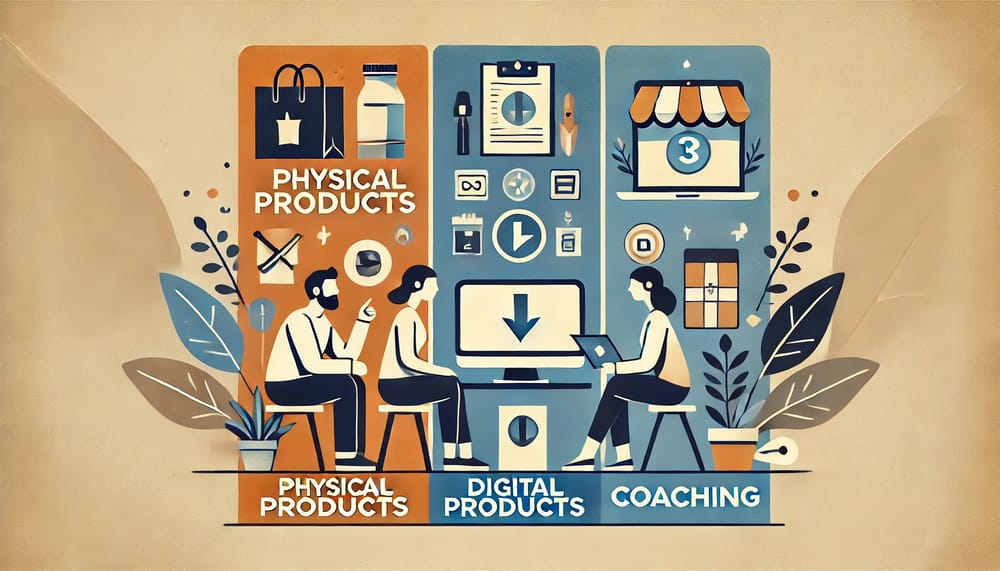
Scaling a business is a goal most entrepreneurs strive to achieve. But not all business models scale equally. For digital marketers and e-commerce business owners, deciding between selling digital products, physical products, or coaching can deeply influence their growth trajectory.
This blog will help you compare these three business models, analyze their scalability, and guide you toward identifying the model that aligns with your goals and resources.
What Does “Scalability” Mean in Business?
Before we break down the specifics, let's define scalability. A scalable business can grow revenue without a corresponding significant increase in costs. The more scalability a business offers, the easier it becomes to add new customers or sales without needing to reinvest heavily in inventory, staff, or infrastructure.
Now, let's weigh the scalability of digital products, physical products, and coaching.
Selling Digital Products
Digital products are intangible items that customers can download, stream, or access virtually. Examples include e-books, online courses, stock photography, software, plugins, and membership subscriptions.
Why Digital Products Are Highly Scalable
1 Low Production Costs
Digital products are created once and sold repeatedly at little to no additional cost. For example, if you create an online course, you can sell it to thousands of customers without additional overhead.
2 Unlimited Inventory
Unlike physical goods, you don’t need to worry about running out of stock or managing warehouses. A single digital file can be replicated an infinite number of times.
3 Automation Potential
Platforms like ClickFunnels allow you to automate your digital product distribution. This means you can focus on marketing and customer acquisition while your platform handles the transactions and delivery.
4 Global Reach
Digital products are not limited by geography. A customer from Australia can purchase your product at 3 AM while you’re asleep, reducing barriers to entry for international business.
Challenges of Scaling Digital Products
While highly scalable, digital products come with hurdles:
- Saturated markets. Your niche may already have competitors selling similar items, making differentiation essential.
- High upfront effort. Building a digital product often requires a significant initial time and effort investment (e.g., creating a course or writing an e-book).
- Marketing dependency. To thrive, you may need consistent investment in your ads, SEO, and social media campaigns.
Still, the profit margins for digital products are enticing, offering a clear path to scalability for businesses willing to establish a strong brand.
Selling Physical Products
Selling physical items is one of the oldest and most common business models. It spans everything from handmade jewelry to dropshipping products on platforms like ClickFunnels, Shopify or Amazon.
How Scalable Are Physical Products?
1 Inventory Management Challenges
Physical products come with tangible limits. You may need to invest in warehouses, production facilities, and shipping. Scaling to meet higher demand often requires negotiation with suppliers, increasing costs.
2 Logistical Constraints
Shipping and logistics pose major scalability challenges. International shipping adds another layer of complexity in terms of taxes, delays, and regulations.
3 Variable Costs
Scaling physical products brings significant variable costs; whether it's raw materials, packaging, or transportation, expenses rise as demand grows.
The Case of Dropshipping
One way to enhance scalability with physical products is to consider dropshipping. By outsourcing inventory and shipping, you reduce upfront costs. However, dropshipping has thinner profit margins and relies heavily on partners, leaving less room for control. ClickFunnels has direct integration with Zendrop and allows for immediate setup for drop shipping, and this might be an option for you if physical products are what you are drawn to.
The Bright Side
Despite its challenges, selling physical products allows for more tactile branding and customer connections. People often associate more value with tangible products, enabling you to charge a higher price point for well-crafted items.
Offering Coaching Services
Coaching is a service-based business model where you provide expertise to help others achieve specific outcomes. Examples include business coaching, fitness training, or personal development coaching.
Scalability of Coaching Services
1 Time Constraints
Coaching is heavily reliant on your time. More clients directly correlate to more hours required, which caps scalability.
2 Customizable Pricing Models
By offering group coaching or creating evergreen paid programs (e.g., pre-recorded workshops), you can reduce time constraints and make coaching scalable to an extent.
3 Authority Building
Coaches often face fewer competitors than physical and digital sellers. Once you establish authority in your field, you can charge premium rates and limit the number of clients to keep operations manageable.
4 Client Retention Opportunities
A loyal coaching clientele often returns for further courses, programs, or ongoing support. Personalized interaction can yield long-term customer loyalty.
Challenges of Scaling Coaching
• Limited geographic reach unless online coaching is utilized.
• The constant need to maintain client satisfaction and prove ROI.
Overall, coaching can develop into a scalable model when supplemented by digital products, like e-books or online workshops.
Which Business Model Is Most Scalable?
If your ultimate goal is maximum scalability with minimal costs, digital products take the top spot. With infinite inventory, near-zero additional costs after creation, and global reach, digital products represent the most streamlined pathway to exponential growth.
However, your ideal business model depends on your resources and skills:
- If you value minimal costs and automation, focus on digital products.
- If tactile branding and customer connections appeal to you, opt for physical products.
- If you thrive on personal interaction and expertise, build your coaching business.
For many businesses, the sweet spot lies in diversifying. For example, you could combine coaching services with pre-recorded courses or sell physical products alongside digital templates.
Final Thoughts on Choosing Scalability
Each business model offers unique opportunities and challenges. Before committing to one, it's crucial to evaluate your skills, your target customer market, and your scalability goals.
And remember, no matter which path you choose, building a business requires consistent effort, creativity, and an understanding of your audience’s needs.
Looking for more guidance?
Russell Brunson teaches you how to create digital and coaching businesses based on your expertise, as well as how to scale an e-Commerce business with their One Funnel Away program, that includes 90 days of ClickFunnels for free.
Click [THIS LINK] to check out that program.
Disclaimer: If you click on links we provide and make a purchase, we may receive compensation. There is never any guarantee of income in any of the links or programs we provide.


Tim Hewitt, Author
Tim is a Freelance Digital Marketer who specializes in helping other marketers to find ways to earn online. When you are frustrated with your prior efforts, Tim will help you find the way!
Copyright © 2026, The Digital Marketing Buzz | All Rights Reserved.