Receive Daily Blog Emails
You agree to receive daily blog emails a link to the full blog contents. You can unsubscribe at any time.
Be Sure To Check Your SPAM Folder For Your Welcome Message and WHITELIST Our Email So It Doesn't Go To SPAM In The Future!
The Real Reason People Buy Standing Desks (It's Not Health)
Monday, October 19, 2026
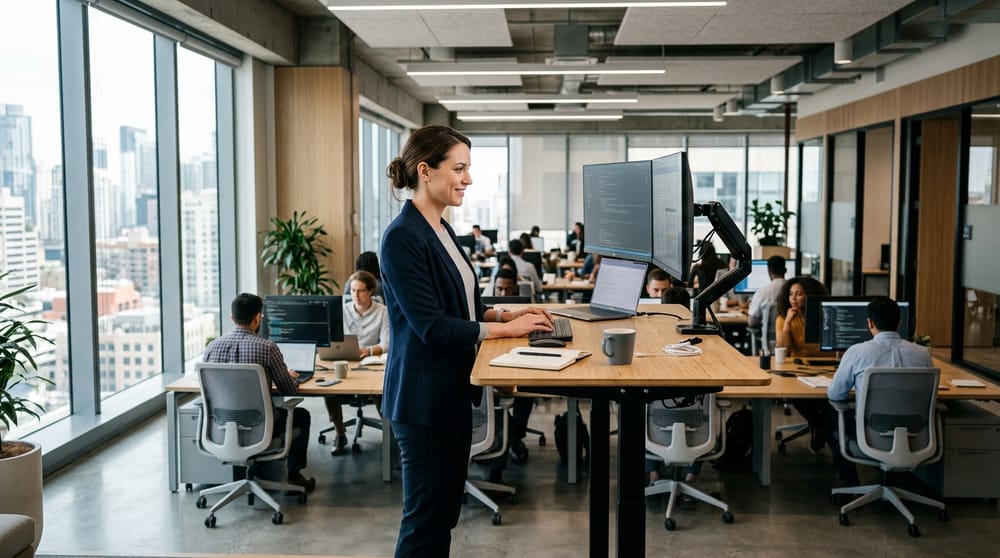
Nobody buys a standing desk for their spine. They buy it so the office can see them working. That's the uncomfortable conclusion I reached after spending three months trying to figure out why a perfectly good product, marketed on perfectly good science, was stuck selling a few hundred units a month.
The client made standing desks. Solid engineering, real ergonomic research behind the design, a founder who genuinely believed sitting was slowly killing his customers. The website said all the right things: reduce back pain, improve posture, boost energy, sit less, live longer. The ad copy was a lecture from a physical therapist. And the growth curve was flat.

My Own Bias, Laid Bare
I'll admit where I started, because it matters. I don't like standing desks. I can't stand up and work all day - I need my butt in a comfortable chair and my brain in a quiet room. So when this client handed me the ergonomics-first funnel and asked why it wasn't converting, my first instinct was that the product itself was the problem. Maybe people just didn't want to stand.
I was wrong about the reason, but right that something deeper than the feature list was going on.
The Discovery: It Was Never About the Spine
We ran customer interviews expecting to hear about lower back pain and stiff hips. Instead, over and over, people talked about something else entirely: how it felt to be the one person standing in a sea of people sitting. One buyer said it plainly - "when my manager walks by, I'm the only one visibly working." Another admitted, almost sheepishly, that she raised her desk right before video calls so she'd "look sharper" on camera.
The desk wasn't solving a physical problem. It was solving a visibility problem.
Visibility Bias and the Theater of Presenteeism
Organizational psychology has a name for this: visibility bias. Managers, even good ones, unconsciously equate what they can see with what is actually happening. A person standing, moving, visibly "on," reads as engaged and productive - regardless of whether their output has changed at all. It's a cousin of presenteeism, the well-documented tendency for face time to influence performance perception more than it should.

Standing in an open office is a signal, whether or not the person standing intends it as one. It communicates busy-ness. It communicates energy. In a room full of seated heads, the standing figure is the one your eye lands on first — and the brain fills in the rest: this person is important, this person is engaged, this person is doing something.
- Visibility bias - perceived effort influences perceived performance, independent of output
- Presenteeism - face time historically correlates with favorable reviews, even when unearned
- Posture and perceived dominance - the (contested) "power posing" research, which still shaped a decade of workplace body-language advice
- Simple figure-ground contrast - the standing body is the one silhouette that breaks the pattern of a seated room
I'm skeptical of power posing as hard science - the original effect has been challenged and partially retracted. But the cultural belief in it is still doing marketing work, whether or not the physiology holds up.
The Video Call Effect
Remote and hybrid work should have killed this dynamic. Nobody can see you stand up in a Zoom square - except they can, and it changes how you show up. Standing shifts your camera angle, opens your chest, puts more air behind your voice. On calls, the standing presenter reads as more energetic, more in command of the room, even when the room is four inches of laptop screen.

Standing changes the camera angle and the energy in the frame - a second, quieter market the ergonomics copy never spoke to.
Office Theater, Not Ergonomics
Once we saw this, we rewrote the campaign. Same product. Same price. Different emotional target. Instead of "reduce back pain," the headline became "be the one who's clearly getting things done." Instead of a diagram of spinal alignment, the hero image showed one person standing amid a row of seated colleagues. We tested both versions against the same audience.
2.4x
click-through rate on the identity-led ad vs. the ergonomics-led ad
61%
of buyers cited "how it looks in the office" in post-purchase surveys
3 mo.
to go from flat growth to the client's best quarter on record
The Marketing Lesson: Sell the Status, Not the Spec
This isn't really a story about desks. It's a story about the gap between the reason a product exists and the reason people actually hand over their money. The ergonomics were true. The back pain relief was real. None of that was the ceiling - the ceiling was that features answer a rational question, and purchases are rarely made by the rational half of the brain.
People don't buy the standing desk. They buy the feeling of being the one who's visibly on. They buy the two seconds their manager's eyes linger on them instead of the person next to them. That's not shallow - it's just how status and attention actually work inside an organization.

Key takeaways
- Feature-based marketing has a ceiling once it has convinced the rational buyer
- The emotional and social driver behind a purchase is often unrelated to the stated function of the product
- Visibility, status, and identity are legitimate - and often dominant - purchase motivators, even in "boring" B2B and workplace categories
- Interview real buyers before you assume you know why they bought
The Twist
None of this means the health claims are false, or that standing desks are a scam dressed up as furniture. Reducing sedentary time is genuinely good for you. But "genuinely good for you" was never going to be what moved this product at scale, because health is a slow, deferred, hard-to-feel benefit - and status is immediate, visible, and felt every single day at 2pm when your manager walks past your desk.
Sell the ceiling, and you'll grow to the ceiling. Sell the feeling underneath it, and you'll find out how big the market actually was.
What's the real reason people buy from you?
Pull ten customer interviews and listen for the sentence that has nothing to do with your feature list. That sentence is your next campaign.


Tim Hewitt, Author
Tim is a Freelance Digital Marketer who specializes in helping other marketers to find ways to earn online. When you are frustrated with your prior efforts, Tim will help you find the way!
Copyright © 2026, The Digital Marketing Buzz | All Rights Reserved.