Receive Daily Blog Emails
You agree to receive daily blog emails a link to the full blog contents. You can unsubscribe at any time.
Be Sure To Check Your SPAM Folder For Your Welcome Message and WHITELIST Our Email So It Doesn't Go To SPAM In The Future!
Improvement vs. New Opportunity: What’s the Real Difference?
Friday, March 07, 2025
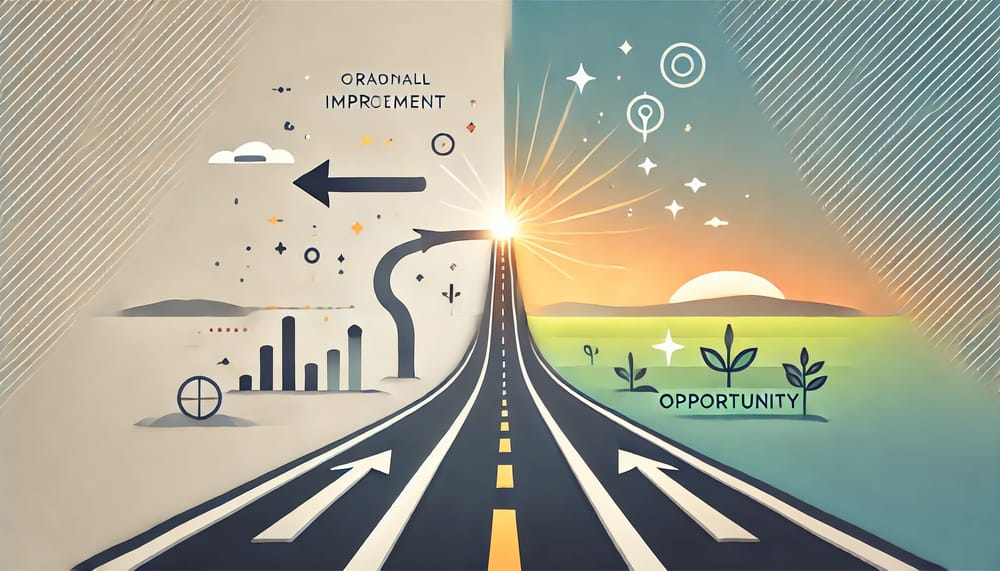
For online marketers and entrepreneurs, growth hinges on identifying ways to captivate your audience and stand apart in your industry. But when creating new offers, crafting marketing strategies, or refining products, you’ll inevitably face a strategic crossroads. Do you focus on marketing your offer as an improvement to what your audience already has, or position it as a new opportunity that opens unexplored paths?
Understanding the distinct difference between these two approaches is crucial for long-term success. The way you position your product or service can significantly influence how customers perceive it, respond to it, and, ultimately, whether they buy it.
By the end of this post, you’ll clearly understand:
- How improvements differ from new opportunities
- The pros and cons of each approach
- When to use each strategy for maximum impact
Sound good? Let's dive in.
What Is an Improvement?
An improvement focuses on enhancing something that already exists. You’re offering a better version of what your audience already uses or knows, whether that’s a product, service, or even an experience.
Examples of improvements include:
- A faster version of your favorite smoothie blender
- A digital marketing tool with updated analytics features
- A new workout program that burns more calories in less time
Improvements appeal to customers who are already familiar with a solution—but are looking for something better. It’s all about upgrading, optimizing, or fixing flaws.
Why Improvements Work
Improvements often feel safe and predictable because they address known customer pain points. They provide answers to questions like:
- "How can I do this more efficiently?"
- "What will make my current process easier?"
- "What isn’t working with what I already have?"
For example:
- Instead of replacing email with a new communication tool, Gmail improved it with smarter inbox filtering and search capabilities.
- Dyson marketed their vacuum cleaners not as a completely new idea, but as an improved version of existing vacuums—no bag, stronger suction, and sleek design.
When to Use Improvements
1 Your Market Is Established
If your target audience already knows and uses solutions similar to yours, positioning your product as an improvement gives you an edge. It’s more about convincing them that your offer is better.
2 You’re Competing on Features or Benefits
Improvements work best in saturated or competitive industries where performance, value, and usability are deciding factors. Highlight how you outpace industry leaders.
However, positioning your product solely as an improvement comes with challenges. You’re targeting a share of an existing market, which means direct competition—and customers may need convincing to leave what they currently use for your alternative.
What Is a New Opportunity?
A new opportunity, on the other hand, introduces your audience to a completely fresh perspective or solution. You’re offering something they didn’t even know they needed—or showing them how to achieve results in a new and better way.
Examples include:
- Airbnb, which transformed lodging by offering homeowners a chance to host travelers.
- Uber reframing transportation with ridesharing instead of taxi services.
- Peloton, combining gym-like spin classes into interactive at-home convenience.
New opportunities often challenge conventional thinking. They solve a core problem, but with unconventional methods or untapped resources.
Why New Opportunities Work
New opportunities ignite curiosity and excitement because they feel innovative and groundbreaking. They solve questions customers didn’t know to ask:
- "How can I completely change the way I approach this problem?"
- "What’s a new way to achieve results I didn’t think were possible?"
- "How can I benefit from this new trend or industry?"
Because they appeal to emotions such as ambition, curiosity, and the desire for transformation, new opportunities drive more significant engagement with certain audiences.
When to Use New Opportunities
1 You’re Entering a New Market
If your product represents a groundbreaking concept (e.g., Think Tesla disrupting the car market), positioning it as a new opportunity opens the door to innovation-hungry customers.
2 You Want to Create Buzz Around Your Brand
New opportunities bring with them a certain level of novelty and excitement. They’re ideal when you aim to attract trendsetters or early adopters who thrive on trying new things.
However, offering a new opportunity also involves educating your market. Unlike improvements, which are familiar, you’ll need to work harder to explain why your product matters and how it fits into your audience’s life.
Small Call to Action Headline
Lorem ipsum dolor sit amet, consectetur adipisicing elit. Autem dolore, alias, numquam enim ab voluptate id quam harum ducimus cupiditate similique quisquam et deserunt, recusandae.
Improvement
Enhances an existing product or solution
Safe, familiar, and predictable
Appeals to upgrading customers
Often competes within an existing market
New Opportunity
Introduces a brand-new solution or approach
Exciting, fresh, and innovative
Appeals to early adopters and ambitious users
Often creates or transforms a market
While improvements rely on familiarity, new opportunities challenge the status quo. Selecting the right approach depends on your target audience and business goals.
Choosing Between Improvement and New Opportunity
Here’s how you can decide which strategy to use:
Choose Improvement If:
- Your audience already uses similar solutions, but their current options are outdated, inefficient, or incomplete.
- You’re entering a competitive market and want customers to switch brands based on features or price.
Choose New Opportunity If:
- You’re launching something disruptive or groundbreaking, with the goal of creating a new category in your industry.
- Your ideal customer is innovative and willing to take risks to achieve transformational results.
Use Both When Possible:
It doesn’t have to be an either/or decision. Some products blend both approaches.
For example:
- Apple markets each new iPhone as both “improved” (better camera, faster chips) and a “new opportunity” (revolutions in phone photography or augmented reality).
Positioning can also shift over time. Uber started as an improvement to taxis, but its later expansion into Uber Eats became a new opportunity.
Whichever strategy you choose, the key to success lies in your messaging. Understand your audience’s needs, pain points, and aspirations. Then, align your product positioning with their motivations.
Looking to refine your offer or craft the perfect marketing message? Start by clearly defining whether you’re an improvement or a new opportunity—and why your audience should care.
Have questions?
Want expert strategies to build your marketing approach?
Come join my FREE Mastermind Group.


Tim Hewitt, Author
Tim is a Freelance Digital Marketer who specializes in helping other marketers to find ways to earn online. When you are frustrated with your prior efforts, Tim will help you find the way!
Copyright © 2026, The Digital Marketing Buzz | All Rights Reserved.