Receive Daily Blog Emails
You agree to receive daily blog emails a link to the full blog contents. You can unsubscribe at any time.
Be Sure To Check Your SPAM Folder For Your Welcome Message and WHITELIST Our Email So It Doesn't Go To SPAM In The Future!
How to Apply the Theory of Constraints to Marketing
Monday, May 19, 2025
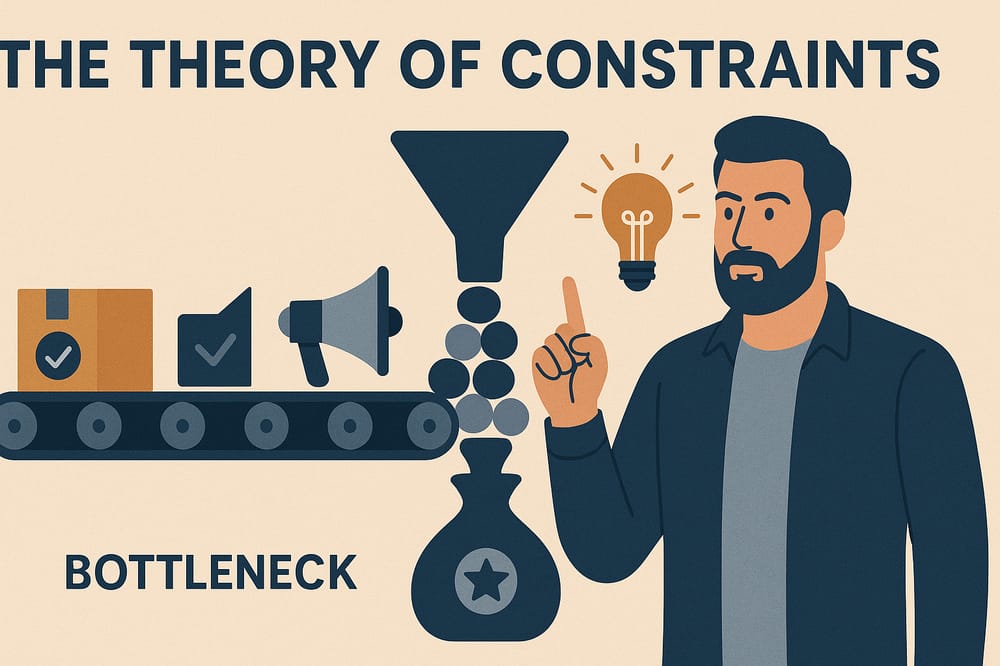
The theory of constraints (TOC) might sound like something straight out of a manufacturing guidebook. While it was originally designed to improve production processes, its principles are surprisingly impactful in a wide range of industries—including marketing. At its core, TOC is all about recognizing and addressing bottlenecks to improve efficiency and achieve better results.
Alex Hormozi, an entrepreneur and marketing expert, has championed the idea that constraints in marketing are often overlooked. By identifying and resolving these bottlenecks, businesses can accelerate growth, improve campaign ROI, and outpace competitors.
This blog will explore how the theory of constraints applies to marketing, break down its key components, and provide actionable steps to improve your strategies. Wherever you are in your marketing career, applying TOC principles can be a game changer.
What is the Theory of Constraints?
TOC is a methodology introduced by Dr. Eliyahu M. Goldratt in his book "The Goal." It emphasizes that every system has at least one constraint, or bottleneck, that limits performance. To improve the system, you need to identify and alleviate that constraint.
For example, in manufacturing, a constraint might be a machine that's too slow to keep up with the rest of the production line. Once you optimize or remove this bottleneck, the system operates more efficiently.
The Core Idea of TOC in Marketing
When applied to marketing, the theory of constraints involves identifying areas where your campaigns or overall strategy are being held back. This bottleneck could exist anywhere in your marketing funnel—from lead generation to conversions to client retention.
If you're running paid ads, for instance, your constraint could be your targeting parameters. Or if you're executing a content marketing strategy, perhaps a slow production process is preventing you from capitalizing on trends. Whatever the case, your growth depends on how effectively you address these bottlenecks.
Why Using TOC in Marketing is Essential
1. Focuses on What Matters Most
Rather than trying to tackle everything at once, TOC forces you to narrow your focus. Marketing teams often get overwhelmed juggling multiple campaigns, platforms, and KPIs. TOC helps you prioritize the one thing that will have the greatest impact and solve for it.
2. Improves the Customer Journey
Marketing is as much about problem-solving as it is about creativity. TOC encourages you to examine your entire customer experience and locate the weak links. Fixing these translates into smoother customer journeys, improved conversion rates, and higher satisfaction.
3. Optimizes Resources
Especially for small businesses and startups, TOC makes it easier to allocate time, money, and effort strategically. By channeling resources toward reducing constraints, you achieve better results without needing to expand budgets or teams unnecessarily.
4. Offers Scalable Solutions
A marketing constraint is not static; addressing one often causes a new bottleneck to arise elsewhere. TOC provides a repeatable framework for identifying and resolving constraints, allowing for sustainable, ongoing improvement.
The Five Steps to Apply TOC to Marketing
Dr. Goldratt outlined five key steps in his methodology, and these apply directly to your marketing efforts:
1. Identify the Constraint
Start by diagnosing the biggest bottleneck in your marketing funnel. This could manifest in a variety of ways:
- A landing page with a high abandonment rate
- Ads failing to connect with your target audience
- Poor email open or click-through rates
- Low customer lifetime value due to poor retention
Ask yourself, "What single issue is having the largest negative impact on results right now?"
Example: Hormozi discusses how, in many cases, businesses pour money into acquiring leads while ignoring their lack of a reliable follow-up process. The real constraint isn’t lead generation; it’s lead nurturing.
2. Exploit the Constraint
Once you've identified the constraint, focus on making the most of it without requiring extra resources. This involves improving what's already in place. If your constraint is a lack of follow-up, for instance, begin by optimizing your current email automation sequences.
Quick Fix Tip: Use data to uncover actionable insights. For example, analyze why people are leaving your landing page. Is it because of unclear messaging or a poor call to action? Make immediate tweaks where possible.
3. Subordinate Everything Else to the Constraint
Devote all your energy and resources to addressing the bottleneck. While it may feel counterintuitive to put other tasks on hold temporarily, this step is essential for results.
Example: If your onboarding emails are the issue, shift your team's focus to improving messaging and implementing A/B tests rather than investing in new ad creatives. Fixing the constraint first will allow all upper-funnel efforts to perform better.
4. Elevate the Constraint
If you hit a stage where further optimization of the constraint is no longer possible, consider investing additional resources. This might mean bringing in external help, purchasing better tools, or dedicating more budget to address the issue.
Example: Suppose email marketing is a consistent bottleneck despite your best efforts. You could invest in better CRM software or hire a copywriting expert to take your campaigns to the next level.
5. Go Back to Step 1
Once your bottleneck is resolved, a new constraint will emerge. The process is continuous, and each cycle of improvement brings you closer to breakthrough performance.
Alex Hormozi’s Insight: Hormozi points out that as marketing systems evolve, the constraints naturally shift. Companies that regularly revisit their bottlenecks are the ones that thrive long-term.
Real World Examples of TOC in Marketing
Case 1: Landing Page Optimization
A SaaS business identified that their landing page was creating high traffic but low sign-ups. By analyzing the page, they discovered their pricing table was difficult to understand, scaring off potential customers. After redesigning the table with clearer visuals, they saw a 37% increase in sign-ups within a month.
Case 2: Email Marketing
A retail brand had a low email click-through rate, despite a robust subscriber list. By re-evaluating their email content, they noticed generic subject lines were the main issue. Personalizing the subject lines immediately boosted click-through rates by 25%.
Case 3: Customer Retention Campaigns
An e-commerce store found that customer churn was its biggest constraint. Introducing a loyalty program and sending personalized discount offers reduced churn by 15% in three months.
Taking the First Step Toward Marketing Success
The theory of constraints offers marketers a valuable framework for identifying and resolving roadblocks that hinder success. By applying TOC, you can maximize the efficiency of your campaigns, increase ROI, and stay consistently ahead of competitors.
The key is to never stop evaluating your system. Marketing, like any other business function, is constantly evolving. Using TOC ensures that you’re continuously improving and adapting to new challenges.
If you’re ready to tackle your marketing constraints and reach the next level of growth, start by examining your funnel through the TOC lens today. For more online marketing insights, click the link and come join my FREE Mastermind Group [at this link].


Tim Hewitt, Author
Tim is a Freelance Digital Marketer who specializes in helping other marketers to find ways to earn online. When you are frustrated with your prior efforts, Tim will help you find the way!
Copyright © 2026, The Digital Marketing Buzz | All Rights Reserved.