Receive Daily Blog Emails
You agree to receive daily blog emails a link to the full blog contents. You can unsubscribe at any time.
Be Sure To Check Your SPAM Folder For Your Welcome Message and WHITELIST Our Email So It Doesn't Go To SPAM In The Future!
Friday the 13th and the Marketing Myths That Cost You Money
Friday, November 13, 2026
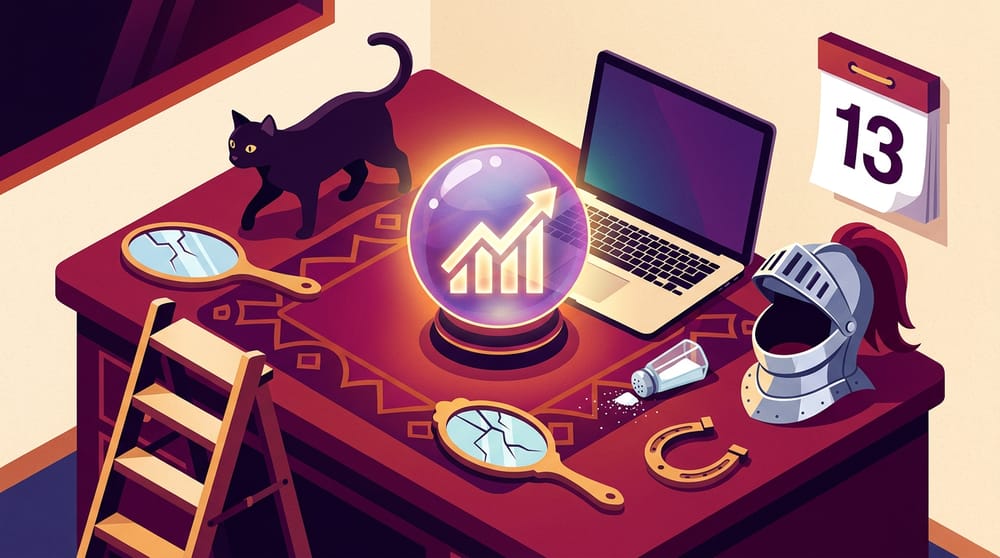
Every few months, someone in a marketing group posts a "rule" with total confidence. Never send email on Mondays. Post on Tuesday at 10am. Nobody reads long sales pages. Everyone nods. Nobody asks where it came from.
That is exactly how Friday the 13th became a legend. And it is a surprisingly good lesson for anyone who spends money on marketing.

The story everyone knows
The Knights Templar tale is a great story
You have probably heard it. On Friday, October 13, 1307, the Knights Templar were rounded up and doomed, and that cursed the date forever. It has drama, kings, secrets and a dash of doom. It is practically begging to be repeated at dinner parties.
Here is the part that is true. King Philip IV of France really did order the arrests of Templars on October 13, 1307. That happened.
Here is where the story starts to wobble.
A real event, a false explanation
The famous execution of Grand Master Jacques de Molay did not happen that day. It came in March 1314, years later. The tidy "one terrible day" version quietly squashes a long and messy timeline into a single dramatic moment.
More importantly, historians have found no solid evidence that people at the time, or for centuries after, linked the Templar arrests to a Friday the 13th superstition. The connection was added later. Much later.
So how did it spread? Modern pop culture helped a lot. Dan Brown's The Da Vinci Code brought the Templar connection to a huge audience and made the tale feel like secret history. It sounded smart. It sounded researched. It was a story wearing a lab coat.
A true event with a false explanation is the most durable kind of myth.
The likelier origin is far less cinematic
Most researchers point to something more ordinary: two older superstitions that merged. In parts of Christian Europe, Friday had a reputation as an unlucky day, and 13 had a reputation as an unlucky number. Put them together and you get a double dose of bad vibes.
The earliest clear written references to Friday the 13th as a specific unlucky date do not show up until the 19th century. Not the Middle Ages. The 1800s. The "ancient curse" is younger than the steam engine in some respects.
The fear even has official names. Triskaidekaphobia is the fear of the number 13. Paraskevidekatriaphobia is the fear of Friday the 13th. Yes, you can win a spelling bee with it. No, it does not make the fear true.

Great stories age well. Accurate ones need to be checked.
How a superstition keeps itself alive
Culture keeps feeding it. Plenty of buildings skip the 13th floor in their numbering, and some airlines skip row 13. In 1907, Thomas Lawson published a novel called Friday, the Thirteenth, which helped push the date into popular imagination. Then in 1980, the horror film Friday the 13th launched a franchise that cemented the date as a symbol of dread.
None of that proves the date is dangerous. It proves the story is sticky.
And then there is the 1882 plot twist. In New York, a group called the Thirteen Club held dinners with 13 guests, on purpose, to poke fun at superstition. They were doing a kind of public A/B test, and the sky did not fall.
The marketing part
The "$800 million" problem
You may have seen the claim that Friday the 13th costs the US economy hundreds of millions of dollars. It gets repeated a lot. It is also very hard to verify. It is not clear who measured it, how, or whether the loss is real or just moved to another day.
It spreads anyway, because it sounds believable. A big number, a spooky date, a confident tone. That is all a myth needs.
Marketing is packed with the same stuff.
- "Never send email on Mondays."
- "Tuesday at 10am is the best time to post."
- "Long sales pages never work."
- "People don't read."
- The screenshot with no source and a very confident caption.
Each one might hold a grain of truth for someone, somewhere, once. But a rule that worked for one audience in one context is not a law of nature. Copy it blindly and you are knocking on wood with a budget attached.
Why smart people fall for it
Myths survive because they are built well.
- A good story. Stories beat spreadsheets for memory every time.
- Repetition. Hear it five times and it starts to feel familiar, and familiar feels true.
- Social proof. If everyone in your feed says it, it must be right.
- Confirmation bias. One flop on a Monday and you remember it forever. The wins on Mondays vanish.
- Internet amplification. A claim can travel the world while its source is still putting on shoes.
Myth-based vs. data-based decisions
A myth-based decision says, "Everyone knows this." A data-based decision says, "Let's find out."
Myth-based
Copies a rule from a guru, a thread or a screenshot, and never checks it against its own results.
Data-based
Treats the rule as a hypothesis, tests it with its own audience, and keeps what actually works.
Your audience is not "the internet." It is a specific group of people with their own habits. Their data beats a stranger's rule every time.

The date is not the enemy. Blind belief is.
Here is the fun twist. Some brands and retailers run playful Friday the 13th promotions, with spooky themes, "unlucky" discounts and cheeky copy. That is perfectly fine. It shows you can use a date as a creative hook without believing a word of the superstition.
Use folklore as a theme. Do not use it as a strategy.
The marketing myth audit
Before you adopt any "rule," run it through these questions.
- Where did this rule come from? Can I find the original source?
- Is it a real event, or a real event with a made-up explanation?
- Who benefits if I believe it?
- Does the proof include sample size, context and method, or just a screenshot?
- Does it match my audience, my offer and my channel?
- Can I run a small test before I bet the whole budget?
- What result would change my mind?
The takeaway
The Templars were real. The arrests were real. The curse was added later, and plenty of people still repeat it as fact.
Your marketing deserves better than a good story you never checked. Question the rule. Test the claim. Keep what holds up.
Luck is not a strategy, and neither is a rumor with good branding.
Want more straight talk?
Subscribe or follow for more marketing advice that actually holds up.


Tim Hewitt, Author
Tim is a Freelance Digital Marketer who specializes in helping other marketers to find ways to earn online. When you are frustrated with your prior efforts, Tim will help you find the way!
Copyright © 2026, The Digital Marketing Buzz | All Rights Reserved.